Military-grade encryption
AES-256-GCM authenticated encryption with Argon2id memory-hard key derivation. Choose Fast, Standard, High or Paranoid.
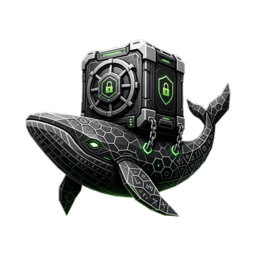
Cryptainer locks your files into portable, password-protected containers on your own device. AES-256-GCM, Argon2id, zero telemetry — the keys surface for seconds and are wiped the instant you lock. Like a whale carrying its cargo through the deep, your data crosses every attack sealed.
Runs entirely in your browser — a faithful illustration of what Cryptainer does to every file you hand it.
Cryptainer never stores the key — only this ciphertext, the nonce, and the tag ever touch your disk.
No magic, no marketing crypto. Real, audited primitives wired together with memory safety from the ground up in Rust.
AES-256-GCM authenticated encryption with Argon2id memory-hard key derivation. Choose Fast, Standard, High or Paranoid.
Bundle many files into a single sealed container. Names, metadata and structure are encrypted — not just the bytes.
Open a container instantly. Each file decrypts on demand the moment you preview it — nothing sits in the clear.
Keys are wrapped in Zeroizing<> and wiped the instant a container locks. Decrypted data is zeroized on eviction.
Export a container to a single .ctnr file. Carry it on a USB stick, import it anywhere. No account, no sync, no server.
No cloud. No servers. No telemetry. Zero bytes leave your machine — verify it yourself, the source is open.
Cryptainer protects your data at rest with a transparent, memory-safe stack — and tells you plainly what it does and doesn't defend against.
A .ctnr sealed on Linux opens, byte-for-byte, on your phone. Builds land here as each platform ships — grab the source any time.
Need the .deb or other builds, or want to compile from source?
Drop in your files and pick a security level. Standard is plenty; Paranoid maxes out Argon2id.
Set a password. Each file is sealed individually with a fresh nonce. No key ever touches the disk.
Close the container — keys vanish from memory. Auto-lock clears it after inactivity, too.
Export to .ctnr and take your vault anywhere. Unlock it on any platform with your password.
Security software you can't inspect is just a promise. Cryptainer is MIT-licensed and fully open — clone it, audit the crypto, build it yourself. Forever free.
Designed & built by forked.online — shipped on platform.forked.online.
Yes. There is no cloud, no account, and no network code in the data path. Containers, keys, and metadata never leave your device. Because it is open source, you can audit this for yourself.
AES-256-GCM authenticated encryption for file contents and metadata, with Argon2id memory-hard key derivation from your password. Integrity is protected by SHA-256 checksums and GCM authentication tags that detect any tampering.
Completely. Cryptainer is FOSS under the MIT license — free to use, inspect, fork and self-build. The full source lives on GitHub.
Windows, macOS, Linux, Android and iOS. One Rust + Tauri core runs everywhere, so the .ctnr format and behaviour stay identical across devices.
Locally — encrypted blobs on disk plus a small SQLite metadata database. You can export any container to a single portable .ctnr file and move it yourself.
Nothing can recover it. No key is stored anywhere, by design — that is the whole point. Keep a backup of important data and use a strong, memorable password or a hint.
Free, open source, and offline by design. Put your files in a vault only you can open.